
In 2026, most patients begin their eye care journey online. They Google phrases like “eye exam near me,” “optometrist in [city],” “LASIK consultation,” or “retina specialist near me,” then compare clinics based on location, reviews, and how clearly services are explained.
The clinics that grow fastest are not always the biggest. They are the ones that use the best eye care marketing strategies to appear in these moments and turn searches into booked appointments. Eye care marketing is no longer a side activity; it is part of how modern optometrists and ophthalmologists deliver care.
This guide walks through the most effective strategies for 2026 and explains how they fit together into a real acquisition system for eye care clinics.
Why Strategy Matters in Eye Care Marketing
Eye care is personal. People worry about their vision, about surgery, about long-term disease. They want to trust the clinic they choose. That means eye care marketing is really about three things: visibility, credibility, and clarity.
A simple pattern appears across successful clinics:
- Patients compare clinics online before they call.
- Eye care clinics rely on local search visibility.
- Strong marketing builds trust before the first visit.
The best eye care marketing strategies in 2026 respect this pattern and support the full patient journey—from first search to follow-up visit.
Explore: The Best Healthcare SEO Agencies for Doctors in 2026
Strategy 1: Dominate Local Search (Local SEO)
If your clinic does not appear in the top local results, you are invisible to a large share of potential patients. Local SEO is still one of the highest-return strategies for eye care in 2026.
A well-optimized Google Business Profile is often the first impression. It should show accurate hours, clear descriptions of services (eye exams, dry eye clinic, cataract evaluations, retina care), real photos of the clinic and staff, and a steady flow of recent reviews.
Local SEO increases visibility for eye care clinics and influences who gets the call when someone needs an appointment today. For optometrists and ophthalmologists, this is not optional; it is a foundation strategy.
Strategy 2: Use PPC for High-Intent Searches
The second major pillar is paid search advertising. PPC drives high-intent eye care leads because it targets people at the exact moment they are looking for help.
Searches like “emergency eye doctor,” “LASIK consultation near me,” “retina specialist near me,” or “contact lens exam near me” often lead to same-week or same-day bookings. Google Ads and Bing Ads allow you to appear at the top of these results immediately.
For 2026, one of the best eye care marketing strategies is a focused PPC program that:
- Targets specific services (retina, LASIK, cataracts, dry eye, pediatric eye exams)
- Uses clear landing pages for each service
- Tracks calls and forms so you know which ads generate real appointments
Eye care clinics benefit from precise keyword targeting, because it filters out casual browsing and focuses on patients with genuine medical needs.
Strategy 3: Build Trust With Social Media and Video
Eye care is highly visual, and patients are often nervous. Seeing your clinic, your equipment, and your team on social platforms can make the decision much easier.
In 2026, some of the best strategies include:
- Short educational videos on TikTok or Instagram Reels explaining common issues like dry eye, floaters, or blurry vision
- Behind-the-scenes posts on Instagram and Facebook that show the clinic environment
- YouTube videos that explain LASIK, cataract surgery, or retina procedures in clear, simple language
Social media ads increase eye care awareness over time. Video content builds trust in eye care providers because it gives patients a chance to “meet” the clinic before they visit. Clinics benefit from consistent visibility when they use social not just to advertise, but to educate.
Strategy 4: Manage Reputation and Reviews Proactively
Online reviews have a direct impact on both local rankings and patient choices. In eye care, where people are anxious about their vision, reviews carry even more weight.
Reviews shape patient trust in eye care. A long pattern of specific, respectful reviews signals reliability. Positive feedback boosts clinic credibility and reassures people who are comparing multiple practices.
The best strategy in 2026 is not to leave reviews to chance. Strong clinics:
- Ask for feedback after appointments
- Use simple systems to request reviews by SMS or email
- Respond politely to both praise and criticism
- Monitor Google, Healthgrades, and other relevant platforms
Reputation management is not just damage control; it is a strategic pillar of modern eye care marketing.
Strategy 5: Keep Patients Engaged With Email and Retention
New patients matter. But the healthiest clinics in 2026 also focus on retention—keeping existing patients informed, scheduled, and connected.
Email marketing maintains patient relationships. It can remind people of annual eye exams, send post-op instructions, explain new treatment options, and share education about conditions like glaucoma, macular degeneration, diabetic eye disease, and dry eye.
Retention marketing increases long-term eye care revenue because returning patients require less advertising spend and are more likely to follow through with recommended care. A simple strategy includes:
- Exam reminder emails
- Contact lens reorder prompts
- Education series for chronic conditions
- Occasional surveys to understand patient needs
This kind of communication supports clinical outcomes and business stability at the same time.
Strategy 6: Use Educational Content to Build Authority
In 2026, one of the most reliable ways to stand out is to explain complex issues in simple language. Patients search for answers to questions like:
- What causes blurry vision?
- When should I see a retina specialist?
- Is LASIK safe?
- What does a retinal tear feel like?
Educational content builds authority in eye care and helps people feel more confident about their decision. High-quality blog posts, guides, and FAQ pages make it easier for search engines and patients to understand what your clinic does well.
When clinics publish clear explanations of eye conditions and treatments, they signal expertise. Helpful information improves clinic perception and supports all the other strategies: local SEO, PPC, social, and email.
Strategy 7: Optimize Your Website for Conversion, Not Just Clicks
Many clinics work hard to get more traffic, but lose patients at the website stage. In 2026, a key eye care marketing strategy is to treat your site as a conversion tool, not just a brochure.
A conversion-focused site:
- Loads quickly on mobile devices
- Shows clear calls to action (call, book online, request an appointment)
- Highlights insurance information and payment options
- Displays authentic reviews and recognisable logos (board certifications, local hospitals, professional societies)
- Explains services in plain, friendly language
Conversion is the bridge between exposure and booked appointments. Without it, even the best campaigns underperform.
Strategy 8: Track Real Patient Acquisition, Not Just Traffic
The best eye care marketing strategies in 2026 share a common habit: they measure what matters. That means tracking not only visits and clicks, but also:
- Calls from Google and PPC
- Online booking form submissions
- Show-up rates for new patients
- Revenue per appointment type (exam, LASIK consult, retina procedure, etc.)
Proper tracking ensures real patient acquisition instead of vanity metrics. When a clinic knows which channels generate actual visits and revenue, it can invest with confidence, cut wasted spend, and refine messaging over time.
Choosing the Right Mix for Your Clinic
There is no single “magic” tactic that works for every eye care practice. A solo optometrist in a small town and a multi-location ophthalmology group will use different combinations of strategies.
But in 2026, the clinics that perform best almost always have these elements working together:
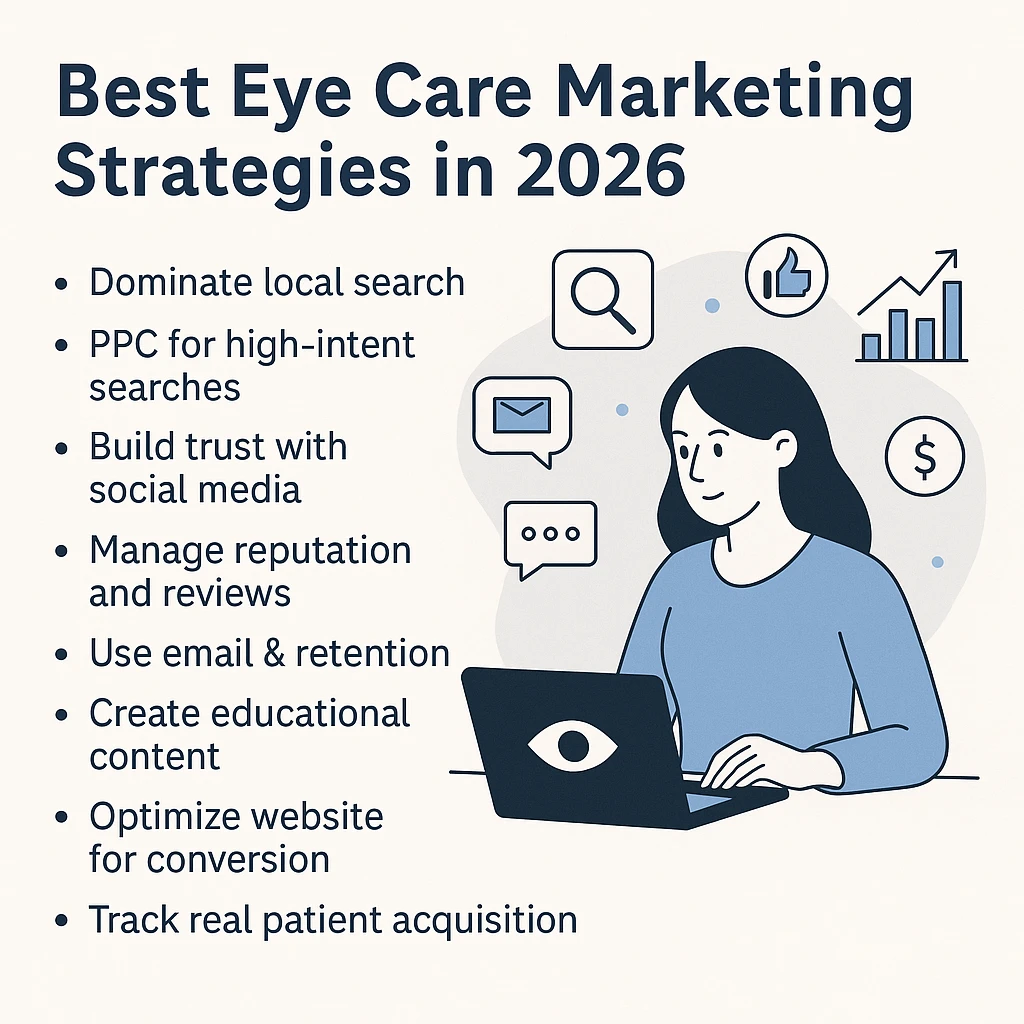
- Local SEO to win local visibility
- PPC to capture high-intent searches quickly
- Social media and video to build rapport and reduce fear
- Review management to strengthen credibility
- Email and retention to keep patients coming back
- Educational content to show expertise
- A conversion-focused website and proper tracking
Eye care specialists require tailored marketing because the stakes are high and the decisions are emotional. Medical expertise improves campaign accuracy, and thoughtful strategies respect the patient’s need for clarity, reassurance, and access.
What “Best” Really Means in Eye Care Marketing
The best eye care marketing strategies in 2026 are not about tricks or aggressive claims. They are about showing up where patients are, telling the truth clearly, and making it easy to take the next step.
When an eye care clinic combines smart local SEO, precise PPC, consistent social visibility, strong reviews, patient education, and careful tracking, marketing stops feeling like a gamble and starts feeling like part of good clinical practice. The result is simple: more of the right patients, better informed, and more confident in the care they receive.
Go To Retina Central